
Executive Summary
This case study provides an anecdotal description of a wildfire incident that impacted the town of Fort Smith in the Northwest Territories, Canada. The wildfire that affected Fort Smith was part of a very significant 2023 wildfire season that affected British Columbia, Alberta, and the Northwest Territories. While the community was never directly impacted by the wildfire it did lead to an extended evacuation and road closures.
The town was protected by a series of high-volume water delivery systems provided by Fire & Flood Emergency Services, Ltd. The incident clearly demonstrated that the company has the following capabilities:
- Rapid response,
- Ability to staff multiple organizational positions,
- Rapid setup,
- Ability to effectively deploy and operate a wide range of specialized resources. The response involved an array of equipment that included:
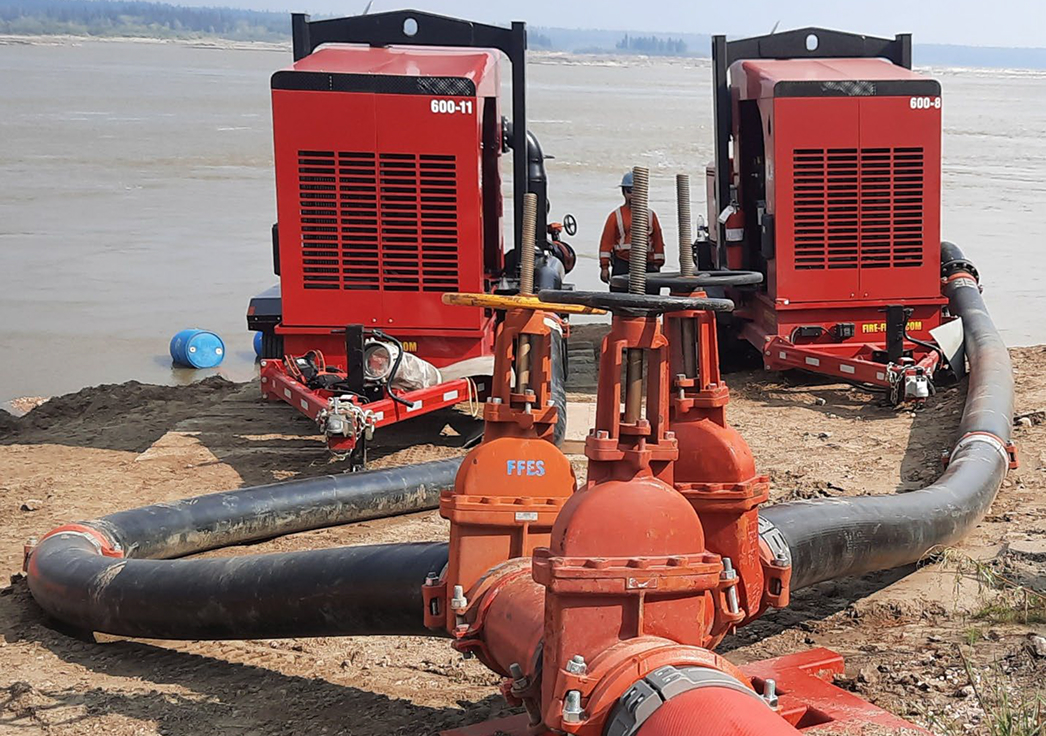
- 16 High Volume pumps capable of up to 36,000 litres/minute through 6 systems,
- 6.8 km of 12-inch Main hose line,
- 12 km of Secondary 4-inch and 6-inch hose Line,
- 48 Water Cannons,
- 250 Satellite sprinklers,
- One 11.5 cubic metre Tactical Tender,
- Four Type 4 Engines,
- An 80 cubic metre helicopter portable tank and hose system.
This was supported by seven leadership and fourteen crew personnel. They were engaged on the incident for 41 days from August 13, 2023, to September 22, 2023.
The scope, scale, complexity, and length of this deployment is notable in the history of wildfire management in Canada.
Introduction
This case study provides a description of a multifaceted incident response provided by Fire & Flood Emergency Services Ltd. for the town of Fort Smith, Northwest Territories from August 13 – September 22, 2023. The case study showcases several aspects of Fire & Flood’s response capability deployed during a long and hazardous period. The study relies on interviews, images, and on-site documentation.
Location
The town of Fort Smith Northwest Territories (NWT) sits along the 60th parallel on the Slave River. The town is in the southeast portion of the NWT on highway 5 (Figure 1). Fort Smith is 272 kilometers south of Hay River NWT, on the single summer road access to the community. The town is located 1,300 kilometers by highway from Edmonton, AB.

2023 Wildfire Seasonal Overview
Regional Wildfire Weather Overview

On August 13, 2023, the Canadian Forest Fire Danger Rating System (CFFDRS) Fire Weather Index (FWI) was extreme (Figure 3). The FWI is an index of the potential for extreme wildfire behaviour incorporating rates of spread, intensity and severity of a wildfire. A FWI greater than 30, as seen in Fort Smith on that day, is associated with full crown wildfires that are beyond most wildfire management resources to stop or control.

Regional Wildfire Overview
Starting on May 29, 2023, numerous lightning caused wildfires started around the town (Figure 4). These wildfires would continue to grow throughout the summer with Fire WB007 becoming the main threat to Fort Smith.
By July 30, 2023, the many wildfires surrounding Fort Smith were active with smoke impacting the community and periodic closures of the single highway out of town (Figure 5).


During the 2023 wildfire season many agencies in Canada were dealing with unprecedented wildfires. The season started early in Western Canada and escalated due to the lake of normal precipitation.
British Columbia, Alberta, Saskatchewan, and the Northwest Territories were managing multiple large threatening wildfires that were beyond their resources. Canadian wildfire management agencies rely on the exchange of resources such as personnel, equipment, and aircraft, from other provinces, territories, and countries through long established mutual aid agreements.
When Eastern Canada began dealing with their own wildfires, Canada started importing international resources. By August most national and international resources were mobilized and critical resource shortages impacted all agencies. By the start of August, multiple NTW communities were at risk and evacuations started to reduce the threat to human life.
August 12 to August 13
On August 12, the town of Fort Smith issued an evacuation order for all non-essential residents to relocate to the town of Hay River NT. On August 13 the most threatening wildfires were twenty kilometers south of the main town and 15 km East of the subdivision of Bell Rock (Figure 6).
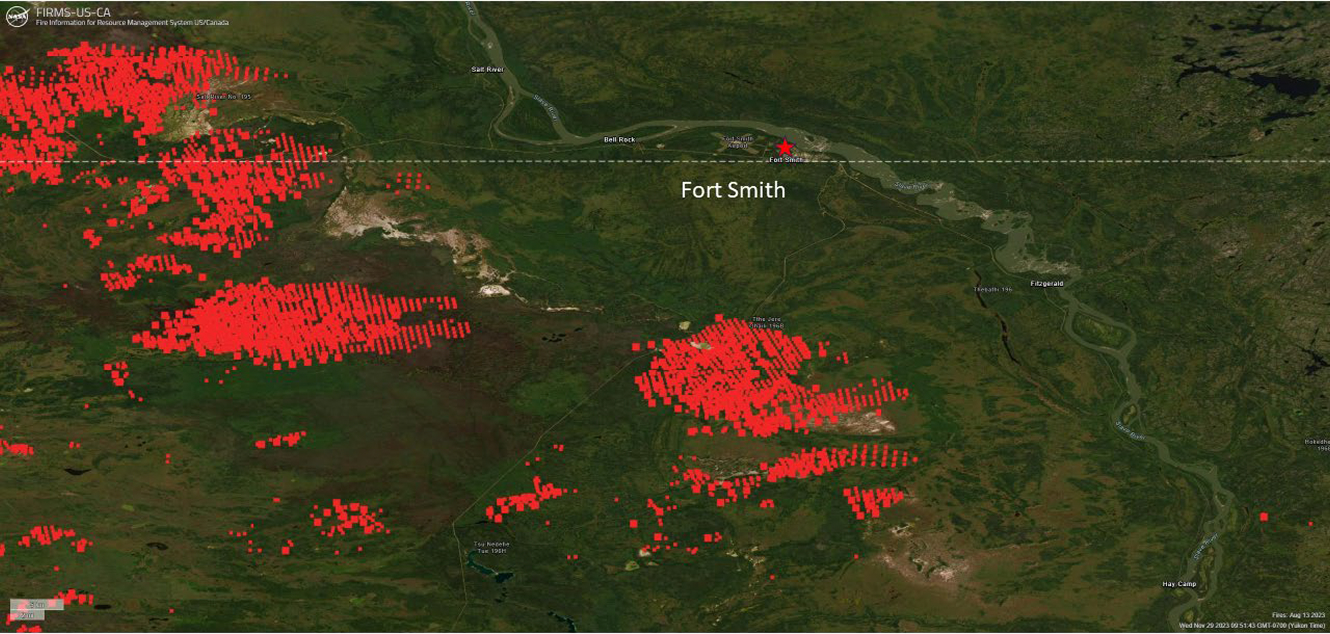
On August 13, Hay River was evacuated with the highway south of the town closed due to a fast-moving wildfire. On that day, wildfire destroyed 90% of the hamlet of Enterprise NWT, forty kilometers south of Hay River on Highway 1. This highway is the single access road into Hay River and Fort Smith.
Incident Narrative
The incident was defined by wildfire WB007 that began in Wood Buffalo National Park approximately 47 kilometers to the south of Fort Smith in late May of 2023. Fire 7, as it was referred to, grew through June, July and early August and joined with other wildfires in the region. On August 12 the wildfire was approximately 23.5 kilometres south and west of Fort Smith. As a result of the potential for this wildfire to reach the community, the town of Fort Smith issued an Evacuation Order on August 12. Fire & Flood Emergency Services Ltd. was dispatched by the town of Fort Smith in the early morning of August 13.
The Fire & Flood team’s response to the incident occurred over a period of 41 days from August 13 – September 22, 2023.
On August 14 the town of Fort Smith was cut off from ground transportation and the remaining emergency responders were limited in their capacity and ability to manage the extreme wildfire situation in the region. The wildfire had advanced from the south and East to within 2.5 kilometers of the main town and 1.5 kilometers from the sub-division of Bell Rock (Figure 7). The wildfire stopped at that location due to change in weather and suppression efforts.

Given the complex nature of the incident for the purposes of this case study we will break the narrative into three periods. Table 1 provides a summary of key dates and times.
Table 1: Chronology of Events August 13 – September 22, 2023
| Date/Time | Action |
|---|---|
| 08/13 12:00 | Fire & Flood receives dispatch request from town of Fort Smith |
| 08/14 03:00 | Advanced Team arrives in Fort Smith |
| 08/14 06:00 | Advanced Team meets with town and emergency managers |
| 08/14 12:00 | Crews and equipment arrive in Fort Smith |
| 08/15 | Advanced Team completing staging and planning |
| 08/16 | Unified Command established with Parks Canada, Northwest Territories and Alberta |
| 08/16 06:30 | Deployment of initial equipment begins on Main Line and West Line |
| 08/16 22:00 | Initial equipment deployment complete |
| 08/17 | West Line pre-rigged/ Helicopter Portable System deployed on SE side of town |
| 08/17 13:00 | Second equipment order requested by the town |
| 08/18 13:00 | Second equipment order arrives |
| 08/18 | West line completed |
| 08/20 | Tamarack system established |
| 08/21 | Bell Rock system established |
| 08/23 | Carl’s Drive system established |
| 08/25 | Log Deck system established |
| 09/22 | Demobilization of systems |
Organizational Phase: August 13-15
The Fire & Flood team received the dispatch request at 12:00 on August 13. They immediately began organizing the response. The dispatch request was to provide resources to defend the community from wildfire encroachment, but it provided limited direction relative to their standard requests. Based on this, the team chose to mobilize an Advance Team of four personnel to complete a site assessment and organize the field response concurrent with the organization and transportation of equipment with the bulk of the personnel required. The Advanced Team attempted to fly from Red Deer AB to Fort Smith, but this was not possible due to complexities arising from the evacuation of Fort Smith. The team disembarked at High Level and transferred to a vehicle to make their way by road. The trip was challenging based on wildfire activity along Highway 1, including the burn over of the community of Enterprise which had recently occurred. The team arrived in Fort Smith at 03:00 on August 14.
The Fire & Flood team stood to at Fort Smith at 06:00 on August 14. At the time of arrival, the command structure and incident organization on site were very limited. This was likely caused by the complexity of the evacuation of the community that had just occurred. This included the relocation of many of the critical emergency response resources such as the RCMP, hospital staff and most of the wildfire management resources. The Fire & Flood team met with municipal officials including the Fire Department and initiated work. For the initial two operational periods the Fire & Flood team played a critical role in supplying and supporting a basic command for the structure protection element of the incident. Staff aided the town in developing objectives and establishing communication and safety plans (Appendix 1). In addition to their role in establishing organizational structure the team played a lead role in establishing the field plan for the deployment of structure protection resources. There was no community protection pre-plan provided that had established priorities and field planning. This led to the team working with the Fire Department to establish priorities and a field plan for the deployment of structure protection resources. The field planning specifically involved determining locations for safety zones, pumps, line locations for supply lines, primary protection zones, water cannons, secondary supply lines, secondary structure protection lines and the establishment of water filling stations for tenders and engines. These phases involved considerable time spent in the field gathering information, establishing options, and developing detailed plans. In addition to planning, the Fire & Flood team developed a series of Staging Areas and Safety Zones. Both elements were critical to later work.
Initial Response Phase: August 16 – 17
Unified Command was established on August 16 comprised of all involved fire management agencies. This provided organizational oversight that allowed the Fire & Flood team and the Fire Department to focus fully on structure protection while wildfire management agencies were active on the wildfire front. The planning that the Fire & Flood team had completed along with the Fire Department identified priority targets and field plans for the initial systems. To this end, the Fire & Flood team working with the Fire Department initiated the deployment of equipment to protect the south and central areas of Fort Smith at 06:30 on August 16.
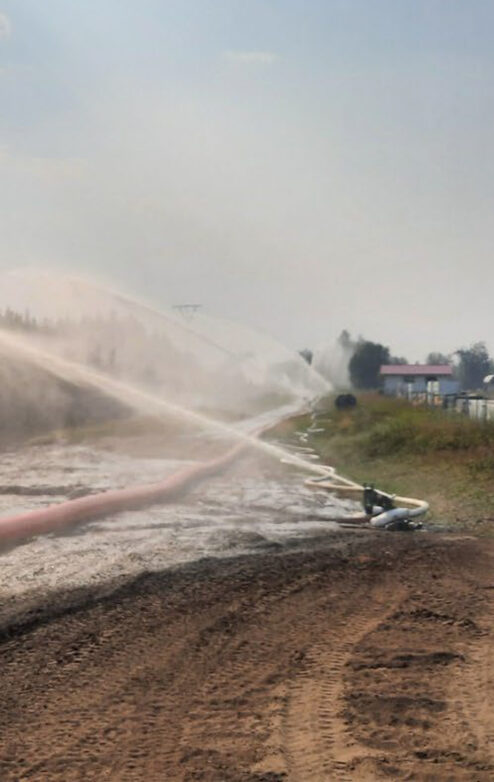
By 22:00 on August 16 the following systems had been deployed (Figure 8):
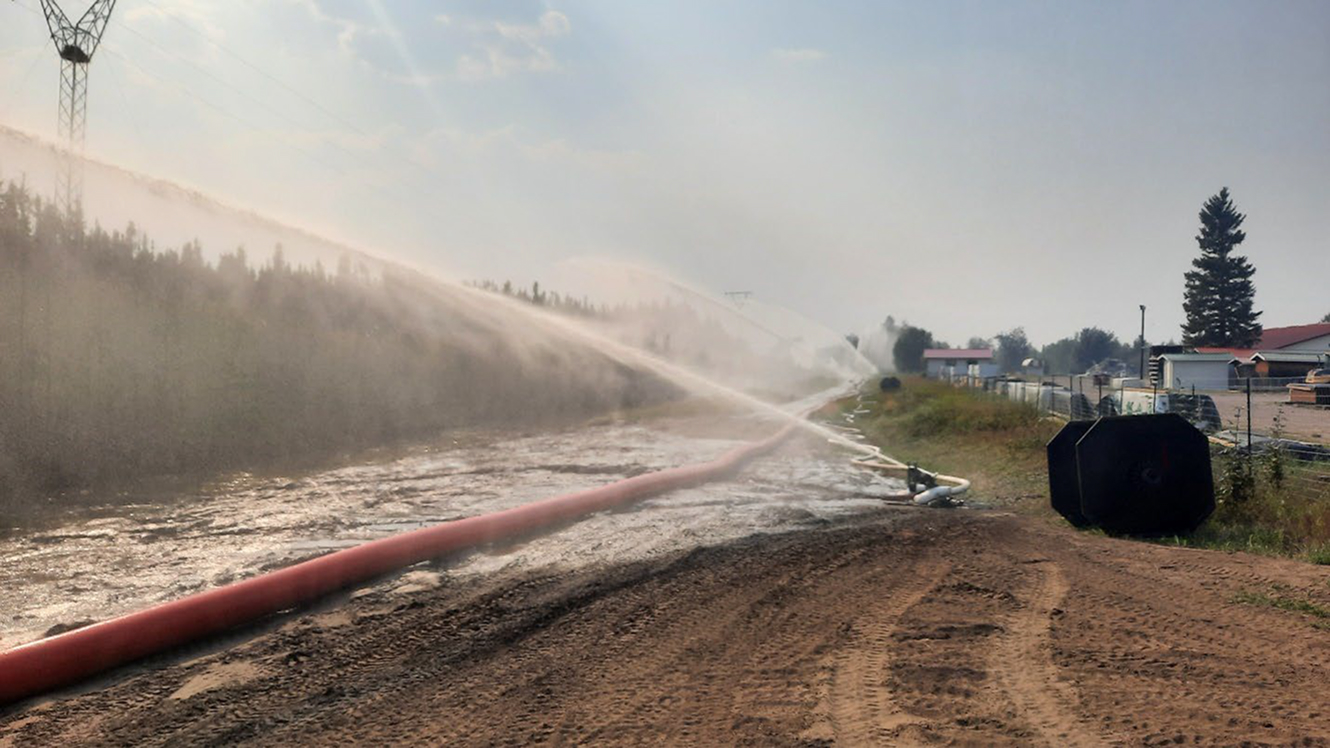
- A main system of three 600hp pumps supplying a 2.0 km 12-inch main line and branch line at the south end of the town providing coverage over 1.8 km with 20 water cannons. When activated the line delivered approximately 24,000 litres of water per minute. This system protected the primary exposure south of town.
- Four satellite sprinkler systems with three smaller 65 hp pumps branching off the mains line were set up on critical infrastructure in the centre of town including a grocery/hardware store, hardware stores, bank, primary Government Building and Incident Command Post, the Town Hall, Special Care Home, and Health Centre. This branch delivered 1000-1500 litres per minute.
- A 91,000-litre water storage tank with multiple speed fill stations were set up for backup and to provide fast water to engines and tenders to enable response to an ember shower should it have occurred.
August 17 saw the further deployment of the Fire & Flood systems that had been initially requested as follows:
- A new line on the west side of the town was pre-rigged for a potential second order using back up pumps and some gear from the first system equipment order.
- A helicopter portable system was set up on the south side of town extending the original southern line to the East using the town water plant settling ponds as a water source.
On August 17 the town ordered additional systems from Fire & Flood to enable further protection of Fort Smith.

Full Response Phase: August 18 – August 25
With the arrival of the second major equipment order on August 18, the West Line was completed and running by the end of the day. With the additional equipment received and other following orders, the system was expanded to satellite locations that protected exposed subdivisions at the wildland urban interface and intermix on the outskirts of the main town. A subdivision located further east of town was protected using a traditional sprinkler system.
- The second equipment order included high volume and secondary pumps, hose, water cannons and vehicles to complete the 2.8 km of 12-inch west line from the original main pump site to through the western boundary of the Town. Two 600 hp pumps delivered 31,200 liters per minute to 26 water cannons.
- Multiple speed fill stations and two major road crossings were included in the west system.
- Three satellite sprinkler systems were set up on three subdivisions (figure 9).
- Tamarac Subdivision immediately west of town on August 20
- Two 75hp pumps supplying 700 meters of 4-inch hose using two portable water tanks.
- This system supplied 27,300 litres per minute to 60-65 sprinkler heads on 31 properties.
- Five 4-inch manifolds for speed loading engines.
- Bell Rock Subdivision 7.7 km west of town on August 21
- One 65 hp pumps supplying 1,580 meters of 4-inch hose from 3 portable water storage tanks each with a 240,000 litre total capacity.
- This system supplied 2,650 litres per minute to 59 sprinkler heads on 34 properties.
- The storage water tanks provided filling stations for engines.
- Carl’s Drive Subdivision immediately east of town on August 21
- One 75 hp pump supplying 900 meters of 4-inch hose from an existing water source.
- This system supplied 1,730 – 2,045 litres per minute to 38 sprinkler heads on 17 properties.
- Three 4-inch manifolds for speed loading engines and tenders.
- On August 8, the final system installed a cannon and sprinkler system to wet down trees that were cut on new fire guards. These cannons kept the decked trees wet so that they would not contribute to the wildfire if it approached the fire guards.
In addition to providing facility protection and wildfire suppression support, Fire and Flood provided additional capacity for the emergency responders in town. The team had in house swift water rescue capabilities in the form of trained personnel and equipment for their staff working next to the Slave River. This capability was shared with other emergency responders. In addition, Fire and Flood personnel trained in emergency medical services (EMS) integrated with the town ambulance to provide those services to all personnel left in town. These services were tested in a site-wide emergency response exercise with Fort Smith EMS, Fort Smith Health Centre, and VIH Aviation Group. While in the maintenance mode of the systems, the Fire and Flood team conducted a steep slope/high angle and Rapid Extraction Module Support training course with Fort Smith emergency responders.

Maintenance Phase: August 25 – September 21
Once the systems had been established the Fire & Flood team along with other resources settled into a maintenance phase. This consisted of running the systems daily based on a priority approach where wildfire behaviour forecasts predicted the most likely place the wildfire could impinge on the values. The systems were continously tested and adjusted to ensure that it was functioning as intended. This phase comprised the bulk of the time for the deployment but is not focussed on in the discussion.
Discussion
The wildfire incident near Fort Smith was a complicated response involving three different wildfire agencies (Parks Canada, Government of Northwest Territories and Alberta) and multiple other agencies in the Northwest Territories. These agencies were all involved in responding to an extraordinary wildfire season that had been ongoing since May. The response challenges were further exacerbated by the evacuation of Fort Smith on August 12. The complexity of this wildfire incident is further demonstrated by noting that other wildfires resulted in Hay River being evacuated on August 13 and Yellowknife being evacuated on August 16. Furthermore, Fort Smith is a remote location in a northern setting that presents challenges to efficient transportation and travel at any time.
We believe that this incident highlights the following elements of Fire & Floods response capabilities:
- Rapid response,
- Ability to staff multiple organizational positions,
- Rapid setup,
- Ability to effectively deploy and operate a wide range of specialized resources. Each of these highlights is expanded upon below.
Rapid Response
A hallmark of Fire & Flood is the team’s ability to mount a rapid response to an incident. In this case they had initial resources (Advance Team of four) onsite within 16 hours. They had significant equipment (Six Transport Trailers) and personnel (Crew of ten) on site within 24 hours. The second equipment and personnel order was onsite within 24 hours. These are impressive results given the scope of the resources being moved. This incident response demonstrates that Fire & Flood has the logistical capacity to mount a rapid response of significant scope and scale to a remote location.
Multiple organizational capabilities
While it is not uncommon for the first one or two operational periods on a rapidly evolving incident to be challenged in establishing an organizational structure, this was an exceptional circumstance. The Fire & Flood team arrived at a situation where the command structure was limited at the outset. The team stepped into this situation and provided basic command and control to ensure the part of the incident they were involved in was provided with safe and effective operations. Specifically, they provided overhead functions including setting objectives and establishing safety and communication plans to the operations within Fort Smith for the operational periods on August 14 and 15. In addition, the team played a significant role in the planning of the structure protection deployment working in close conjunction with the town Fire Department. Within two operational periods the team had established priorities and laid out a complex field plan for a substantial deployment of resources. Upon the establishment of Unified Command on August 16 the Fire & Flood team shifted into a more traditional role as a resource within a Structure Protection Branch of the Incident Management Team. They remained as the primary structure protection resource, and it is worth noting that the initial planning they completed formed the basis for the remainder of the response.
This incident response demonstrates that Fire & Flood has personnel with the expertise to perform multiple functions on an incident. Their ability to step into difficult situations and assist an entity that is in difficulty while maintaining organizational structure to enable safe and effective operations is a strength.
Rapid Setup
The Fire & Flood team working in conjunction with the Fire Department established the initial system on August 16 in one 15.5-hour operational period. The systems established in that operational period consisted of the following equipment:
- Three high volume pumps
- Five 65hp portable pumps
- 3 km of 12-inch hose line
- 1.7 km of secondary hose line
- 20 Water Cannons
These systems combined to provide an approximate 27,000 litres per minute of water delivery over an approximate 1.8 ha area.
The Fire & Flood team working with the Fire Department went on to complete several setups of significant structure protection systems over the subsequent week. Each of these systems was rapidly established.
While these systems can deliver large volumes of water over a significant area, the Fire & Flood team has developed the expertise to enable rapid deployment of these large systems. This is made possible through training, practice, and a strong logistics team. The logistics team capabilities are worth noting as the systems arrive with equipment redundancies that ensure rapid deployment capability without critical pieces missing. Practically, what this means is that the team arrives with a wide array of fittings to tie into the variety of hydrant/water delivery systems that may be encountered. This is relevant both in the way they can tie into water supply systems and in how they can supply a wide variety of water delivery systems such as tenders and engines.
Ability to effectively deploy and operate a wide array of specialized resources.
The Fire & Flood delivery includes an assortment of emergency management equipment to meet a range of incident objectives. The team’s ability to provide command and planning support is documented above. From an equipment perspective this incident provides a lens on the depth of the Fire & Flood capabilities. This deployment included the following equipment:
- 16 High Volume pumps capable of up to 36,000 litres/minute through 6 systems,
- 6.8 km of 12-inch Main hose line,
- 12 km of Secondary 4-inch and 6-inch hose Line,
- 48 Water Cannons,
- 250 Satellite sprinklers,
- One 11.5 cubic metre Tactical Tender,
- Four Type 4 Engines.
- An 80 cubic metre helicopter portable tank and hose system.
These primary equipment components were supplemented by a supply of secondary equipment such as fittings, tanks, a skid steer, all terrain vehicles, a service truck, winch trucks, a mulcher, and rescue equipment. All this equipment is designed to allow the Fire & Flood equipment to plug and play into a wide variety of water delivery and supply systems. This enables the team to draw water from a variety of sources and supply water to a variety of resources such as tenders, engines, water tanks, and helicopter water delivery systems. Based on these flexibilities and redundancies, the system can, and in the Fort Smith incident did, provide a back-up hydrant system to the existing municipal system. This is a valuable element that increases the probabilities of success in a wildfire impingement.
Along with the ability to deliver equipment, the team can also deliver the support personnel to effectively deploy and operate the systems. This deployment saw the team provide seven Leadership and fourteen crew personnel. Not only did these personnel deploy rapidly as documented above, they also maintained staffing levels for what amounted to over a month-long deployment to a remote location. The team also provided a swift water rescue and emergency medical service capability. Given the situation in Fort Smith, which was under evacuation order through September 18, the Fire & Flood crew provided a critical service that improved the safety of not just their team but for all responders.
Conclusion
Even though the wildfire never reached the suppression lines established by Fire & Flood in Fort Smith, this extended deployment demonstrated several key capabilities of the company. The team joined the incident under very trying circumstances linked to the full evacuation of Fort Smith. Despite many challenges they were able to work with the Fire Department to establish operations, develop a plan and execute the plan within a short time frame. They expanded the initial systems to provide protection to the entire community in a very short time frame. They evolved and maintained the established systems for over a month to provide ongoing protection for the community. The scope, scale, complexity, and length of this deployment is notable in the history of wildfire management in Canada.
Appendix 1: ICS Forms developed by Fire & Flood Team
Incident Objectives (ICS 202)
Incident Name:
Ft. Smith / Structure protection
Operational Period:
Date from Aug 14 / 2023 to Aug 15 / 20
Time from: 18:00 Time to: 18:00
Objective(s):
- Triage Community Values by priority, location, and survivability
- Define and or Improve LACES Lookouts, Anchor points, Communications, Escape routes, Safety Zones 3: Establish a Staging area and manage this site accordingly
- Grid the Community with zones for patrol and spot fire response 5: Establish high volume pump site, supply lines, and fill sites
- Support and improve WUI structure sprinkler systems, and or sprinkler guard systems
- Define, prioritize and mitigate all hazards within and surrounding the community for WUI operations
Operational Period Command Emphasis:
Objectives based on the 18:00 WUI operational meeting at the FT. Smith fire hall with:
- Town of Ft. Smith Council members
- Town of Ft. Smith Fire Department
- Structure protection team / Clearwater County
- Structure Protection Contractors from Fire & Flood Emergency Services, Wildcat Fire /Services
- Parks Canada Wildfire Liaison, NWT Wildfire Liaison
- Ft. Smith town Maintenance staff
General Situational Awareness:
- Ft. Smith Council and fire Department direction and approval
- Wildfire weather and sit rep briefings from the Parks Canada Liaison
- NWT, Liaison input and basic communication
- Alberta WUI / SPU team input and mentorship
- Fire & Flood Emergency Services / Wildcat Fire input and mentorship
Site Safety Plan Required?
Yes. Approved Site Safety Plan(s) Located at: Ft. Smith Fire Department.
Prepared by:
Troy O’Connor
Structure Protection Specialist
Approved by:
Ft. Smith Fire Chief Adam McNab
Incident Objectives (ICS 202)
Incident Name:
Ft. Smith / Structure protection
Operational Period:
Date from Aug 14 / 2023 to Aug 15 / 20
Time from: 18:00 Time to: 18:00
Safety Message / Hazard Identification, Safety Plan, Emergency Response Plan:
Important:
- Keep your gear pack and your day pack containing all your essentials, including meals ready
- Always turn your vehicles pointed out when working so you can drive straight out
- Assess hazards on an ongoing basis and communicate concerns with adjoining forces
- Mitigate hazards after reviewing hazard controls with your supervisor and the management
- Monitor your radio – we don’t have cell coverage, so radio communication is vital
- Communicate all operational deployment and check in frequently when working
- Lookouts, Anchor points, Communications, Escape Routes, and Safety zones must be pre planned updated and improved whenever and wherever possible!
Hazard Identification:
- Airport LPG, Hydrogen @ Parks space, LPG tanks throughout the community
- Gas Bars, and Card lock stations, homeowner fuel storage, South junk pile / contamination
- Ammonia plants at the arenas, Utilities corridors, low hanging overhead lines etc.
- Wildfire entrapment hazards, Dangerous animals (wild and domestic), traffic – low visibility
- Wildcard hazards that have not been Identified that should be communicated to the group
- Changing weather and wildfire conditions that affect fire behavior in the WUI
- Wildfire ignition operations and unplanned escalating fire conditions
- Euthanized, Hogs? Bear safety Evacuation plan Summary:
- Define and improve your escape routes to safety zones at all times
- Safety Zone A: King Street Sand pit (college training area)
- Safety Zone B: Airport Terminal (Parking area)
- Safety Zone C: Fitzgerald Boat Launch (East)
- Safety Zone D: Salt Mountain gravel pit (West)
- Communicate your intentions and locations when traveling
- Team Leaders must provide for accountability and supervision of your team member’s Emergency Response Plan for injured workers:
- Communicate your location of incident and nature of injuries to your supervisor
- Survey the scene and ensure safety of medical responders
- Request medical response on Ambulance repeater, Ch 3
- Provide ongoing casualty care and basic life support until handover
- Assist with medical response and communicate all actions with your supervisor
Site Safety Plan Required?
Yes. Approved Site Safety Plan(s) Located at: Fire Department.
Prepared by:
Troy O’Connor Structure Protection Specialist
Appendix 2: Photos from Fort Smith Deployment



Wildland Fire Works Consultants who authored this report were:
Mike Etches – Forty years of experience in managing wildland fires at the crew, Duty Officer, Incident Management Teams and executive management levels. Mike’s focus includes tactical and strategic planning, the Planning Section Chief function and Team Development
Rick Kubian – Forty years of experience in managing landscape wildland fires in protected areas, prescribed fire, Duty Officer. Incident Management teams and executive Management. Rick’s focus includes tactical and strategic planning, the Incident Command function and Team Development.
The contents of this report are the intellectual property of Wildland Fire Works. You may not reuse, republish, or reprint such content without our prior written consent.
All information provided is for informational purposes. Should you decide to act upon the information in this report, you do so at your own risk.
While the information in this report has been verified to the best of our abilities, we cannot guarantee that there are no mistakes or errors.

