Fire
Fire

Canada’s wildfire seasons are growing longer and more destructive. Wildfires have cost Canadian communities billions in damages, displaced hundreds of thousands of residents, and claimed lives. In 2023 alone, 15 million hectares burned across Canada, seven times the national average, with 232,000 evacuations and 120 days at peak preparedness. The 2024 Jasper fire destroyed 358 structures. Fort McMurray in 2016 caused $9.9 billion in damages.
When wildfire reaches the wildland-urban interface, where fire meets the edge of developed land, demand for water at the Fireline can exceed tens of thousands of gallons per minute. During a major incident, power outages stop pumps, infrastructure becomes compromised, and municipal systems face draw volumes they were never built to handle. Water supply becomes the limiting factor, and that is the gap Fire & Flood was built to fill.
Sources: Government of Alberta, Natural Resources Canada, Insurance Bureau of Canada.
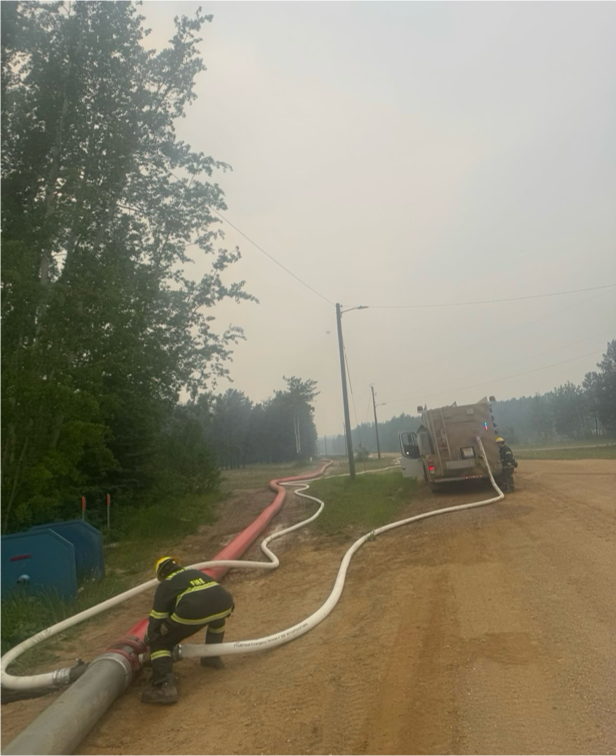
Fire & Flood deploys as a specialized operational resource under agency direction, fully integrated within established Incident Command System (ICS) structures. Our patented wildfire suppression systems function as high-volume mobile hydrant networks and suppression curtains, moving water tens of kilometres from rivers, lakes, and other viable sources across challenging terrain and varying elevations. The result is a continuous, pressurized water supply delivered independently of municipal infrastructure and grid power, providing sustained water supply / suppression capacity where it is needed most.
With more than 60 operational deployments across Canada and documented results under active fire conditions, our mobile hydrant technology is protected by issued patents in Canada, Australia, and the United States.

Our patented above-ground mobile hydrant systems move water from viable sources across challenging terrain and varying elevations, supplying a continuous, pressurized water supply and suppression.
Sustained delivery of tens of thousands of gallons of pressurized water per minute able to establish defensive coverage around communities and critical infrastructure while providing extended Fireline protection and additional water supply capacity for ground crews, engines, tenders, and aviation assets. Operating independently of grid power and municipal water infrastructure, our systems and crews remain fully self-sufficient, minimizing demands on scarce resources during wildfire events.


Fire & Flood works with public safety agencies, municipalities, Indigenous governments, and critical infrastructure operators to develop custom, service-backed infrastructure protection plans before events escalate. Proactive readiness is strategic.
Mobile Support Tanks provide 80,000 litres (20,000 gallons) of water storage capacity and are equipped with engineered accessories that enable rotary-wing aircraft to safely and efficiently draft water. Designed for day and night operations, MSTs create a controlled and reliable water source that enhances aviation effectiveness during emergency response and wildfire suppression activities.
Mobile Support Tanks (MSTs) provide additional water storage capacity for temporary airtanker bases, community protection operations, and rapid engine and tender filling. They can directly supply Structural Protection Systems (SPS), support hand crews, and establish strategically located water sources that enhance operational efficiency and wildfire suppression capabilities.


Fire & Flood deploys a 36-foot Mobile Command Centre designed to support Incident Command System (ICS) operations in the field. The unit includes dedicated workstations for all five ICS functions, a private office for Command staff, five telephone lines, three Kenwood VHF radios, and a large smart-screen display, Starlink, a cellular booster system, and an exterior touchscreen briefing monitor provide reliable communications and operational coordination in remote and dynamic environments.


Proactive readiness is strategic. Fire & Flood works with public safety agencies, municipalities, Indigenous governments, and critical infrastructure operators to develop customized, service-backed emergency response plans that provide actionable options, defined response capabilities, and operational certainty when emergencies occur.
Our planning process includes site map development, alignment with agency and community objectives, and full integration into established ICS frameworks. Fire & Flood brings the operational experience to make those plans credible and the equipment to execute them in the field.